Stage 5 Insights · November 2, 2026
Founder Independence: Grow Without Everything Depending on You

You start the day intending to work on the business. Before you get there, someone needs a pricing approval. A customer wants you involved in a delivery problem. Two managers need a decision about who owns the next step. By the afternoon, the priorities you planned to work on are still waiting.
The business is growing. So is the amount of work coming back to you.
That puts pressure on everyone, especially the person at the top. The question is whether the way the business operates has kept pace with the demands you’re placing on it.
Growth exposes what the business hasn’t built yet
Processes that worked at one level of volume can struggle at the next. Informal handoffs become unreliable. Information arrives late. People work around gaps because customers still need the work delivered.
Your employees usually feel it first. The P&L starts showing it, too. Rework consumes hours you can’t sell again. Expediting adds cost. Managers spend time recovering from problems instead of preventing them. Customers and suppliers feel the inconsistency.
When experienced people decide it’s too hard to work here and leave, the same volume falls on fewer people. The pressure compounds. Delivery and quality can deteriorate further. Customers buy less or find another supplier.
Revenue may pull back faster than the business can adjust the costs it added to support growth. Margins compress. Cash comes under pressure. What developed gradually can become urgent very quickly.
“A bad system will beat a good person every time.”
That’s a useful reminder before you conclude that people simply need to work harder. Look at what the business requires them to do and whether they have a workable way to do it.
Find out why the work keeps coming back
A founder often becomes the workaround. You know the customer, remember the exception, understand the pricing or have the authority to make the decision. Stepping in keeps things moving today. Repeating that pattern can leave the business increasingly dependent on your intervention.
Telling a manager to take ownership won’t resolve an unclear role. Delegating an approval won’t help if the person lacks the information to judge it. Adding another employee won’t necessarily fix a process that creates unnecessary work.
Before changing the organization, investigate the reason for the dependency. Which decisions genuinely require you? Which return because people lack authority, information, a dependable process or the preparation to act?
Five connected foundations
I’ve seen these same issues in so many businesses. As founder-led businesses grow, most encounter several of these challenges, and many encounter all five. The businesses that work through them build the capacity to keep growing without sending everything back to the person at the top.
These are the five foundations I look at. I start with dependency because I want to understand why decisions and work keep coming back. Then I look at who owns the work, whether leaders have the financial information to make decisions, how the work gets done and whether people are prepared to carry it. That order helps me understand the business. The changes often need to happen together.
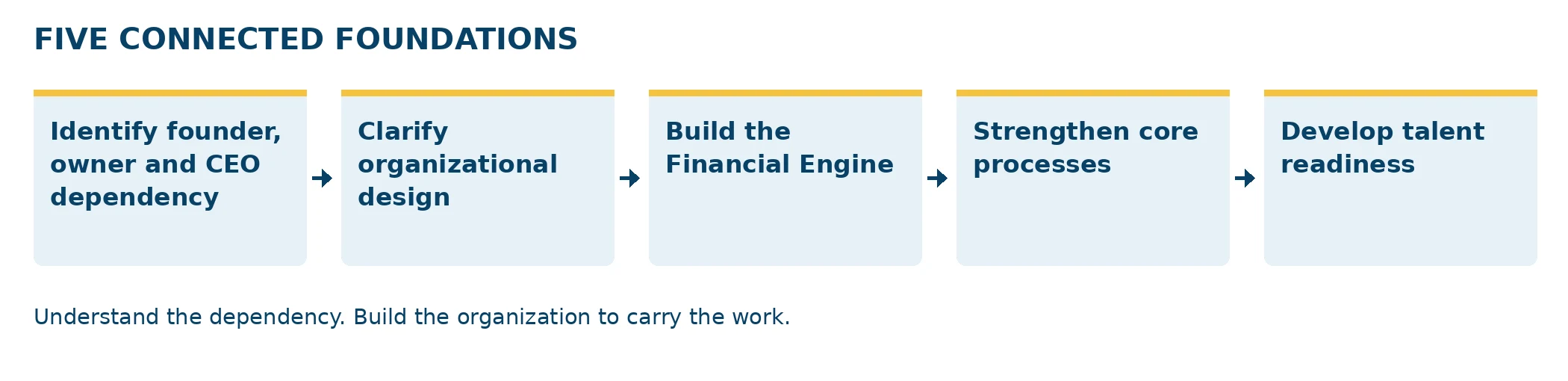
Follow the dependency through the organization. Address the connected gaps together.
1. Identify founder, owner and CEO dependency
Follow the decisions and work that keep returning to the top. Include customer relationships, exceptions and the knowledge people rely on you to carry. Ask why each item comes back before deciding what to delegate or change.
Some responsibilities should remain with you. The opportunity is to distinguish those from work the organization could carry with the right support.
2. Clarify organizational design
Ambiguity about who owns what and who is allowed to make which decisions creates a ton of problems. Work gets duplicated or dropped. People wait for approval, step into someone else’s responsibility or send decisions back to you because the boundaries aren’t clear.
I want people to understand the results they own, how their responsibilities connect to others and what they are empowered to decide. A title or an organization chart doesn’t establish all of that.
Be specific about authority and escalation. A manager responsible for delivery needs to know which scheduling or resource decisions they can make, when they need input and what should come back to you.
3. Build the Financial Engine
Are you using the amount of cash in the bank to judge whether the business is doing well? If that’s your primary measure, you may be closer to a major problem than you realize as the business grows.
Don’t get me wrong. Cash is king. Your bank balance tells you how much cash is there today. On its own, it doesn’t tell you what will be left after payroll, supplier payments and the costs of the next stage of growth. It doesn’t tell you whether the work you’re taking on is profitable or when the cash from it will arrive.
I want leaders working from reliable, timely financial information connected to the business. Accurate records, reconciled accounts and a regular close establish the starting point. Understanding profitability, cash requirements and variances makes that information useful.
Our Stage 5 Financial Engine work connects those records to controls, forecasts and regular review. Leaders should be able to explain what changed, investigate why and decide what to do next. Finance also needs to give them access to the supporting detail required to answer those questions.
4. Strengthen core processes
Examine how work moves from a customer commitment through delivery and collection. Look at the handoffs, tools and controls people use, along with the workarounds they have developed.
This is where inefficiency often creates margin leakage. Waiting, rework, duplicate entry and inconsistent execution use time and resources without adding value. Improve the way the work happens so people have a dependable process to follow.
5. Develop talent readiness
I look at how people are actually performing against what their roles require. Confidence and capability don’t always line up, and a gap that was manageable at one stage can become dangerous as the business grows. More volume and more complex decisions put that gap under pressure.
I’ve heard some version of this many times over the years: “If everyone was as good as they think they are, we wouldn’t have any problems.” There’s a useful warning in that. People’s confidence in their performance doesn’t always match what the role requires, and growth can make that gap harder to ignore.
If your approach to development is to tell people to go figure it out, with some occasional coaching when something goes wrong, you’re probably going to struggle as the business grows. People need clear expectations, honest feedback and deliberate preparation for the responsibilities they’re being asked to carry.
Talent readiness needs to be a process. Define what each role requires, assess performance against it, agree on development priorities and give people the training, coaching and experience to improve. Review progress regularly and adjust. That process needs to help people perform today and prepare them for what comes next. It belongs in the way you run the business, with clear ownership and regular follow-through.
Put the changes into operating practice
The work has to reach the way people run the business. Agree on priorities and responsible owners. Put the reports, processes and decision authority into use. Establish an operating rhythm that makes progress and unresolved issues visible.
Then check whether it works. Are decisions staying with the right people? Are handoffs becoming more reliable? Can leaders explain their results and address gaps? Is less routine work returning to you?
That’s the connection between strategy and execution. We help leaders make the organizational and operating changes that allow their intentions to become part of daily work. Depending on the need, that can involve consulting, coaching and training, or fractional and interim leadership alongside the team.
Have the conversation while you still have options
Too often, I get the call when the owner is lying awake wondering whether they’ll make payroll. By then, the operating strain has reached the point where cash is dictating the decisions. I wish that conversation had happened much earlier.
“It happens slow, then fast.”
You don’t need to wait for that moment. Start with three decisions or activities that repeatedly come back to you. For each one, find out what prevents someone else from carrying it and what the business needs to change.
Founder independence gives you more choice about the role you play. You may want to grow, remain actively involved, prepare someone to succeed you or eventually sell. Strengthening the business around you supports those choices.
